From Spreadsheet to System: How Customer Rewards Work at Scale


Customer reward programs scale meaningfully when a qualifying action recorded in the CRM or commerce system automatically triggers the correct reward, while business controls eligibility, exceptions, and program economics. In short, when a new recipient or new campaign creates no more administrative work.
Most customer incentive programs begin manually. A team exports a list, checks who qualifies, buys the rewards, sends them, records what went out, and reconciles the spend. That process works for the first 50 recipients. At 5,000, the administration becomes the program.
Automation turns a repeated administrative task into a rule. The rule can run at higher volume without proportionally more people to run it. And that’s how customer incentive programs scale.
How does marketing incentive software integrate with CRM systems?
A customer completes a qualifying purchase, makes a successful referral, reaches a loyalty program milestone, or switches provider. The event is recorded somewhere: Salesforce, HubSpot, a commerce platform, or another customer system. That system acts as the source of truth. Relying on this source of truth as an oracle, marketing incentive software then actions the reward.
A good integration keeps the commercial logic upstream (eligibility) and the reward delivery system downstream. The path is predictable: customer action, eligibility confirmed, reward value set, reward delivered, and distribution recorded. That’s all there is to it. What the customer actually receives at the end of that chain is its own design decision.
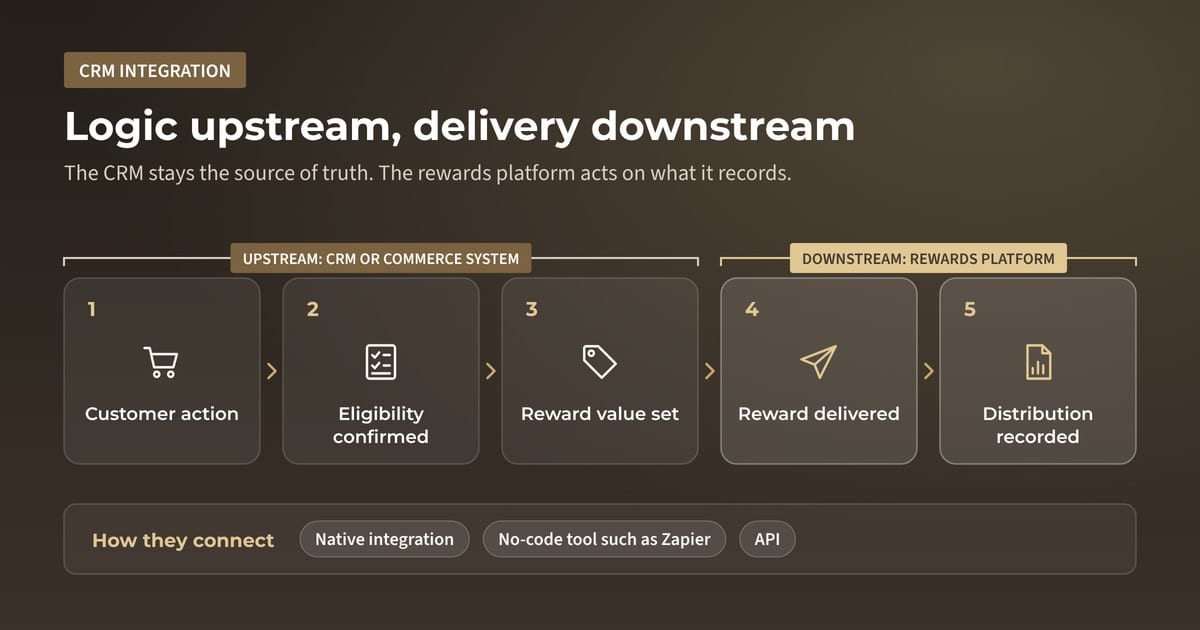
Marketing incentive software is designed around existing systems, and most platforms connect to a CRM through a native integration, a no-code tool like Zapier, or an API. Many also build custom, event-driven workflows. These platforms understand their place and are designed to fit within existing systems.
Leading marketing incentive software platforms Giftogram, Tremendous, and Tango all offer no-code tools like Zapier, an API, or native CRM integrations with Salesforce, HubSpot, and others. Giftogram’s gift card API is one example of a product designed to support custom, event-driven workflows.
What are the best practices for integrating incentive software with a CRM?
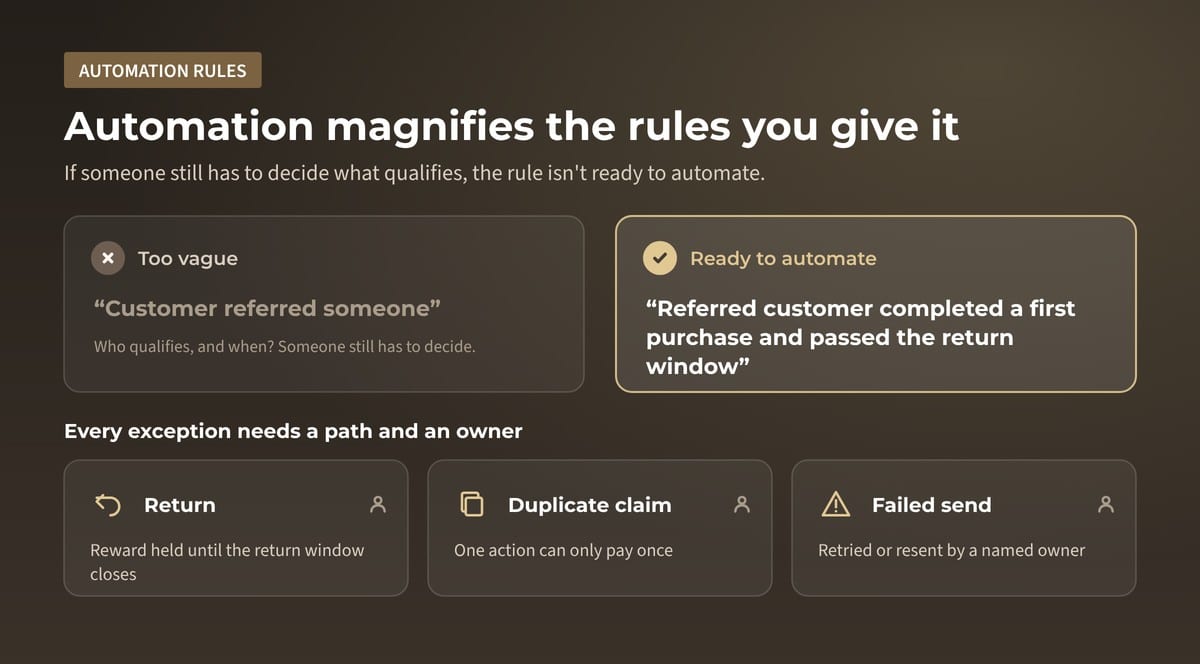
Define the qualifying event precisely, keep eligibility in the CRM, and give every return, duplicate claim, and failed send an exception path and an owner. Automation is deterministic and built on rigid rules, so it will magnify the quality of the underlying rules. Hence, enterprises must define them clearly.
Deciding which customer actions to reward is a commercial decision. The business needs to make it, and it comes before any automation. For example, “customer referred someone” will likely not be precise enough. A stricter rule, such as “referred customer completed a first purchase and passed the return window,” will lead to a better, clearer incentive program.
The same discipline applies to purchases, renewals, and rebates. Keeping each stage separate means you can check each one when something goes wrong. Automation only carries out decisions the business has already made. So again, the clearer the rule set, the better the results. If it still requires someone to decide what qualifies, it is not ready for automation.
Harvard Business Review’s “CRM Done Right” drew the same lesson from CRM projects that worked (2004). They aimed technology at clearly defined customer problems and paired it with process design and clear performance measures.
When should a customer rewards program use native integrations, Zapier, or an API?
Use a native integration for standard CRM events, Zapier to connect common apps without engineering, and a customer rewards API when rewards must sit inside a proprietary product, the logic is highly specific, or the volume justifies it. In conclusion, the right integration is the simplest one that reliably handles the program.
| Route | Use it when |
|---|---|
| Bulk send or spreadsheet upload | The campaign is scheduled or one-off |
| Native integration | Rewards follow standard CRM events, such as a closed deal or a renewal date |
| Zapier | The qualifying event sits in an app with no native connection |
| Customer rewards API | Rewards sit inside the company's own product, the logic is too specific for a connector, or volume justifies the build |
For example, a scheduled campaign may need no integration at all. A recurring CRM-triggered reward may only need a no-code workflow. Businesses should consider an API only when reward delivery needs to sit deeper inside the company’s own systems.
Giftogram is an example of a rewards program built around this progression logic. Teams can start with built-in integrations and no-code workflows for standard use cases, then move to its public API, webhooks, and sandbox environment when the program needs custom development.
Why automate customer rewards?
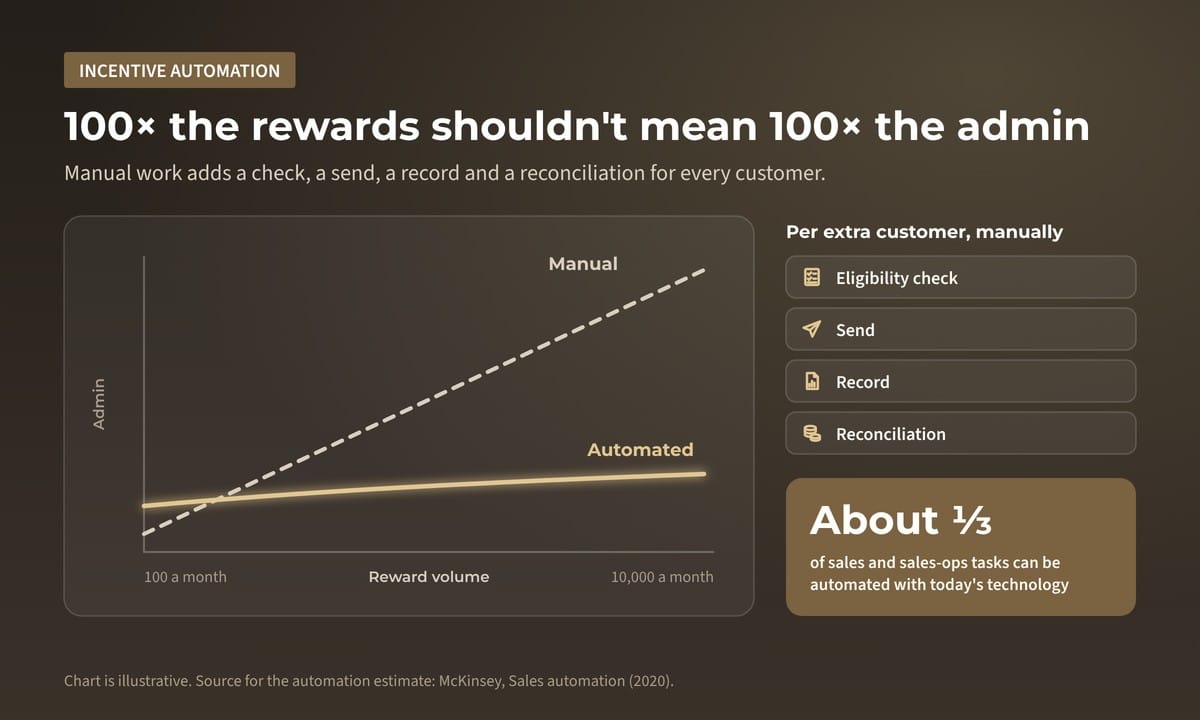
Each manual reward adds to the administrative burden, so marketing incentive automation makes the most sense once the reward volume outgrows the team running it.
Manual work has a hidden unit cost. Every additional customer creates another eligibility check, send, record, and reconciliation step. McKinsey estimates that roughly a third of sales and sales-operations tasks can be automated with existing technology, with early adopters reporting efficiency improvements of 10–15% (2020). That research covers sales automation broadly, not customer rewards. The principle carries over: repetitive administrative work is a strong candidate for automation.
Consider a referral program that produces 100 successful conversions a month. A team can reasonably deal with that list from verification to reconciling the spend. But if the same program grows to 10,000 successful referrals a month, doing it by hand is simply not feasible unless the company has an army of unpaid interns. If the CRM already records when a referral qualifies, the better model is to let that event trigger the reward automatically and record the distribution at the same time.
One hundred times the reward volume should not require one hundred times the fulfillment administration. Automation earns its pay by breaking that relationship.
What should built-in analytics on an incentive platform report?
Visibility will always be vital. Automation is only helpful if a business can still see what the program is doing. If rewards are sent automatically, a reporting layer must let people see what was sent, to whom, for which program, when, and at what cost.
The real value of analytics comes from a complete picture. An incentive platform shows that a $50 reward was issued and the CRM shows it followed a successful $2,000 referral. Another system shows that the qualifying purchase was later returned. Looking at any of these in isolation gives an incomplete, and therefore, wrong picture.
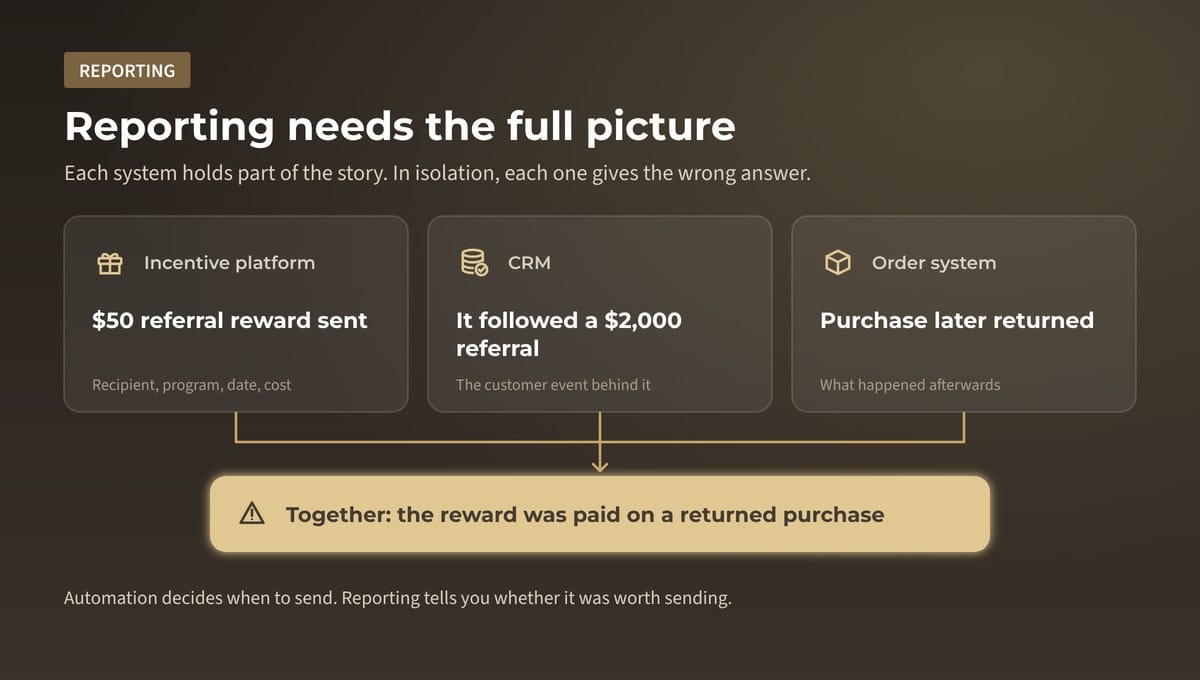
Businesses need a bird’s-eye view. Different platforms naturally offer different solutions; Giftogram’s reporting dashboard should show every reward issued with its recipient, program, send date, and cost. Commercial ROI requires connecting that data back to the customer event.
It comes back to simple maths: automation tells the system when to send the reward, and reporting tells the business whether it was worth sending.
Which customer incentive platforms have the strongest integrations?
Top-rated customer incentive platforms such as Giftogram, Tremendous, and Tango all connect to major CRMs, so the best integration depends on which one fits the systems already holding customer data. It should also allow deeper automation as the program grows.
Still, the number of integration logos is only one part of the decision. A useful platform should support straightforward workflows for non-technical teams, deeper API access when required, reliable reporting, and enough implementation support to resolve problems when live programs hit exceptions.
| Capability | Giftogram | Tremendous | Tango |
|---|---|---|---|
| Enterprise use | Dedicated enterprise offering, large-scale incentive automation, onboarding and customer-success support. | High-volume sending, enterprise security, API support and compliance controls. | 4,000 enterprise customers, enterprise portal, API, reporting and customer/recipient support. |
| Automation routes | Bulk upload, built-in integrations, Zapier, 100+ integrations, public API and webhooks. | Bulk upload, direct integrations, Zapier and API. | Native Salesforce, Qualtrics and Zapier integrations, broader Workato connectivity, plus API automation. |
| Automation routes | Separate sandbox plus public API documentation. | Free sandbox, API documentation and developer support. | Sandbox/test console and API documentation. |
| Standard digital pricing | No platform, setup, or onboarding fee for standard digital rewards; digital gift/prepaid cards generally cost face value. Physical prepaid cards carry a handling fee. | No subscription or platform fee for standard gift-card sending/API use; some monetary payout methods carry fees. | Free in most cases; gift cards generally cost face value, while some funding methods carry fees, including 2.9% for credit-card funding through the API. |
Integration breadth is very easy to market and similarly easy to overvalue. What really matters to business is whether the platform can reliably sit inside the workflows they already use. Focus on the platform that allows a slow start, deeper automation when necessary, and clean recoveries if something breaks.
How to Choose a Customer Incentive Platform compares platforms, costs, and payout options side by side. Start with a spreadsheet and move to rules once the program has proven itself and the volume justifies it.
Frequently asked questions
Which marketing incentive software integrates with CRM systems?
Most rewards platforms connect to Salesforce and HubSpot. Check two things: whether the CRM can trigger a reward, and whether the reward’s status flows back to the customer record. Giftogram can sync recipients from more than 100 apps and send a reward automatically when a CRM record meets criteria set in Zapier.
What are the best practices for integrating sales incentive software with a CRM?
Trigger the reward from a CRM stage the sales team cannot change on its own, such as a deal marked closed-won after finance approval. Hold the reward until any cancellation or refund window has passed. Match each rep to a single record so one deal cannot pay twice, and test the trigger in a sandbox before real money moves.
Which marketing incentive platforms have built-in analytics?
Most rewards platforms include a dashboard showing what was sent, delivery status, and spend. Look beyond sends to claim status, since an unclaimed reward is budget that has not reached the customer. Check that reports can be exported for finance to reconcile.
What are the top-rated customer incentive platforms with integrations?
Review sites such as G2 are the usual reference, and ratings among the leading platforms are close, with Giftogram, Tremendous, and Tango leading. Read what reviewers say about setup, sync errors, and support when an integration breaks. A score built on hundreds of reviews tells more than a high score from a small sample.
Have you read?
How Ukrainian Contractor Taras Kasianchyk Is Expanding His Home Renovation Business in the U.S..
Why AI Job Growth Claims Are Outpacing Evidence.
Bill Reed: From Tire Sales to B2B Finance.
Nivia Fontanez: Supporting the Future of Medical Imaging Operations.
Six Legal Support Options After a Serious Personal Injury.

Follow CEOWORLD Magazine on: Google News, LinkedIn, X (Twitter), and Facebook.
Note: The views expressed are those of the authors and do not necessarily reflect those of CEOWORLD Magazine, its Editorial Board, or management. Content is provided "as is," may contain monetized links, and is not professional advice. See our Ethics & Guidelines for details. Reproduction requires prior written permission.
Contact info@ceoworld.biz for inquiries or media requests.