


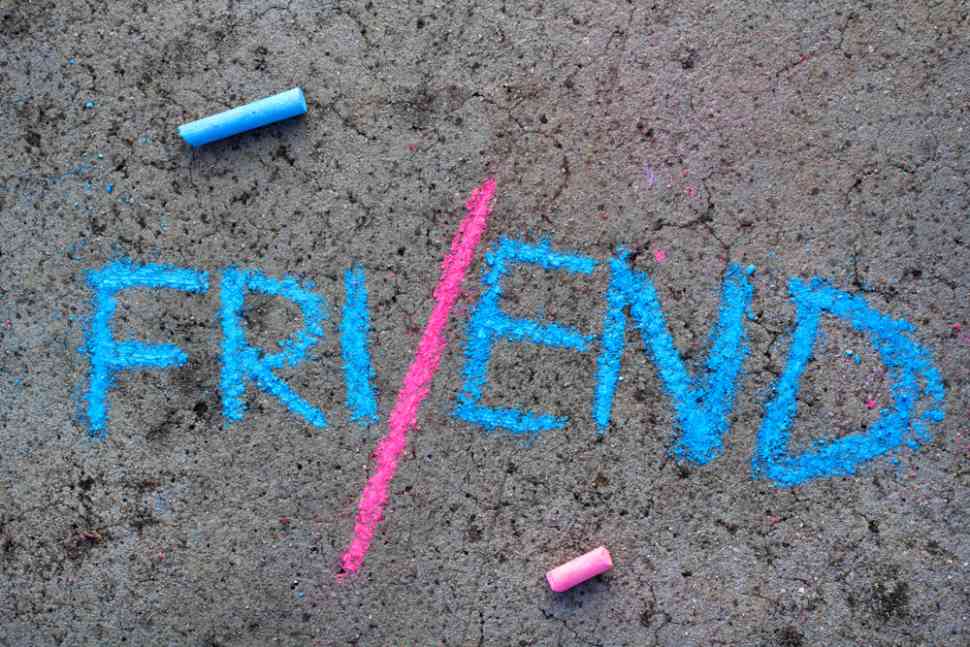
Having friends is a source of balance for an individual’s life, but not a few are the cases where we stop being friends with people and either replace them with others or leave a gap in their place. Today we talk about all those reasons that drive friendships to end.
- Taking different paths in life
As we grow older, we change. Some people say ”You have changed” as if this is bad. Well, the answer to this is ”yeah, I have. I haven’t worked that hard to remain the same.” Changing is a part of the process, and you should be proud of it. As part of your evolution as a human being, it is expected that you will not have as much in common with some people in the future. Sharing a similar pattern in life is what makes us have similar interests, likes, dislikes, and habits. When none of these are common it is hard to keep up with someone; you have more things that separate you than the things that further bond you. A good example of that is the friend we have in college. We don’t know them since we were little kids, so the bonding is not so strong while at the same time, some of us may make families, some may focus on their careers, while some may turn out to be adventurous travelers. - Geographical distance is a form of distance
Sometimes simple stuff like moving out of the city can play the same role. If, for example, the company you work for asks you to manage the department of another country, many things will have to change in your life and friends are one of them. You don’t necessarily have to cut them out, and it is ideal to try staying in touch with them for the first months at least. Still, eventually, you will lose touch with one another, and perhaps at some point, you will come back home to visit family, and you won’t even bother to call your friends. Geographical distance is a challenge, and the friendship will have to be strong to escape the trap. - Negativity appears long the way
Sometimes relationships start, and they seem to have the best potential, but as time goes by, the good feelings you have for one another fade out until they disappear entirely. People start to compare themselves to others and become competitive. This is where jealousy enters, and the relationship becomes toxic. The friends stop having good intentions. The situation is unbearable because not liking someone is fair enough, but having to pretend you are friends with them is awful. There will be a point that none of you will be able to stand that, and the friendship will come to an end. As disappointing as this is, it often happens unexpectedly, and we have to make our peace with it. Friendships are usually hard to break because they are not complicated, and people do not have conflicting interests. Competitiveness, jealousy, and negativity are signs of conflicting interests; even when they are not related to financial or any other solid issues, they affect our unconscious mind and psychology. - Betrayal can be the breaking point
Losing the trust you once had in your beloved friend is an important reason to end things between you too. To be honest, trust comes first in most of our relationships out there, and when one of us acts in a way that makes us suspicious of them, it demands a lot of effort to try to rebuild the broken relationship. It takes time to build trust, but this can tear apart only in a few seconds if the people involved do not prioritize their confidence in each other. Seeing someone ready to give up on you when the hard days come is disappointing. At younger ages, boyfriends and girlfriends may be a reason to betray a friend, and as we grow older, we believe threats are less; however, there is always motivation to act like that. For older people, career issues can make people set apart, and it is a matter of principles whether you will stick with your friend or care only for yourself.
Add CEOWORLD magazine to your Google News feed.
Follow CEOWORLD magazine headlines on: Google News, LinkedIn, Twitter, and Facebook.
This report/news/ranking/statistics has been prepared only for general guidance on matters of interest and does not constitute professional advice. You should not act upon the information contained in this publication without obtaining specific professional advice. No representation or warranty (express or implied) is given as to the accuracy or completeness of the information contained in this publication, and, to the extent permitted by law, CEOWORLD magazine does not accept or assume any liability, responsibility or duty of care for any consequences of you or anyone else acting, or refraining to act, in reliance on the information contained in this publication or for any decision based on it.
Copyright 2024 The CEOWORLD magazine. All rights reserved. This material (and any extract from it) must not be copied, redistributed or placed on any website, without CEOWORLD magazine' prior written consent. For media queries, please contact: info@ceoworld.biz
SUBSCRIBE NEWSLETTER