



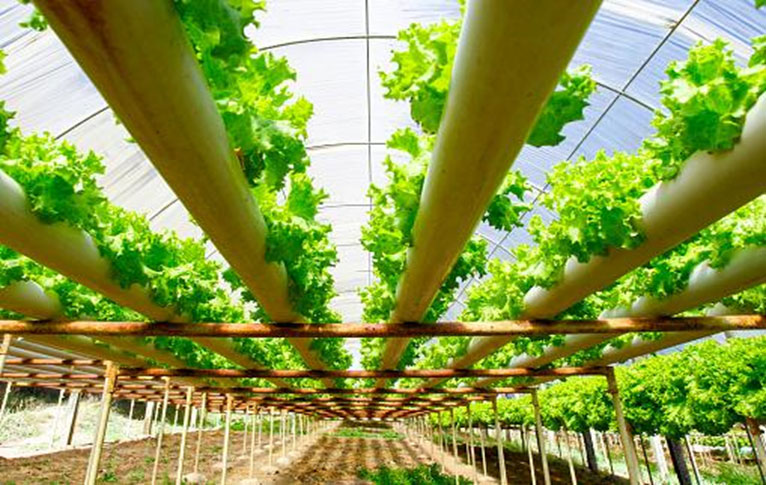
The global agriculture industry is facing several challenges like increased demand for food, a global rise in calorie consumption, and rising insecurities in the food supply chain. In such a situation Hydroponic Farming is considered to be a potential solution that can satisfy the demands for a healthy and plant-based diet.
What is Hydroponic Farming?
Hydroponic Farming is cultivating and growing vegetables and plants without any soil. It is all about farming with only water, necessary nutrients, and sunlight. These water-based plants are free from harmful pesticides and chemicals and grow much faster than soil-based plants. The best part is that you do not a large acres of farmland to start hydroponics. You can easily convert your terrace, windowsills, vacant farmhouses, and empty lands into hydroponic systems. Many urban and city dwellers are practicing vertical hydroponics, where more than 20 pots can thrive together in a meager 3×3 sq. ft. space.
Plants that can be grown
You can grow a huge variety of plants using this new system. From lettuce, cucumber, and spinach, to capsicum, radish, and ginger, you can grow almost everything. Try out basil, chives, and other herbal plants as well. Hydroponics is the reality of the self-independent dream of ‘eat what you grow.’
How does it work?
In Hydroponics, plants do not have any soil base. The roots of the plants are immersed in nutrient-rich water, instead of a soil base. The water runs directly into the roots and you need to replace the water every fifteen days. If you have an automatic water recycling system, then you need not worry about changing water. Plants grow in a perfect environment, pH balanced, nutrient-rich, and plenty of sunlight. The result is that plants grow 15 times faster as compared to soil plants and gives you healthier and nutrient-rich outputs.
Market size
This industry will have a total market size of 9.5 billion USD in 2020. At a CAGR of 11.8%, you can expect the hydroponics market to reach almost 16 billion USD in another five years. Big MNCs always look for investment opportunities in smaller profitable ventures, and this industry is not an exception. It is indeed the best solution to tackle global food insecurities in the coming years.
Advantages of Hydroponic Farming
- Easiest farming technique
No need for large lands, soils, chemicals, and fertilizers; can farming be easier than this? This is the most convenient way of growing rich, healthy plants and vegetables. - Keeps costs to a minimum
Without soil, fertilizers, and pesticides, where will you have any scope of incurring costs? More so, these plants grow 10 – 15 times faster than traditional soil-based plants. Hence, cultivators can expect huge quantity of plants in no time. With minimum investment in setting up the hydroponic system, you can get immense returns. - Saves Water
Most of the water used in the field cannot be recycled; most of it either evaporates or muddles with the soil and is simply lost. Hydroponics consumes 10 times less water and you can even recycle the water again and again.
Though certain minor challenges remain like the growth of algae, the spread of any kind of water-borne diseases, and the availability of labor, yet Hydroponics is the future and no doubt several MNCs and startups are eyeing this as a highly profitable venture for the future.
Have you read?
Crewed MegaYacht charter in Greece and the Greek Islands.
The World’s Best Luxury Superyacht Charters And Builders.
Luxury Superyacht charter in Greece and the Greek Islands.
Add CEOWORLD magazine to your Google News feed.
Follow CEOWORLD magazine headlines on: Google News, LinkedIn, Twitter, and Facebook.
This report/news/ranking/statistics has been prepared only for general guidance on matters of interest and does not constitute professional advice. You should not act upon the information contained in this publication without obtaining specific professional advice. No representation or warranty (express or implied) is given as to the accuracy or completeness of the information contained in this publication, and, to the extent permitted by law, CEOWORLD magazine does not accept or assume any liability, responsibility or duty of care for any consequences of you or anyone else acting, or refraining to act, in reliance on the information contained in this publication or for any decision based on it.
Copyright 2024 The CEOWORLD magazine. All rights reserved. This material (and any extract from it) must not be copied, redistributed or placed on any website, without CEOWORLD magazine' prior written consent. For media queries, please contact: info@ceoworld.biz
SUBSCRIBE NEWSLETTER